Get to know your roof
A site visit looks at usable space, shade, access and your household’s energy needs.
A thoughtful solar system for the place you call home. Understand the possibilities, then take the next step.
Explore your roof’s potential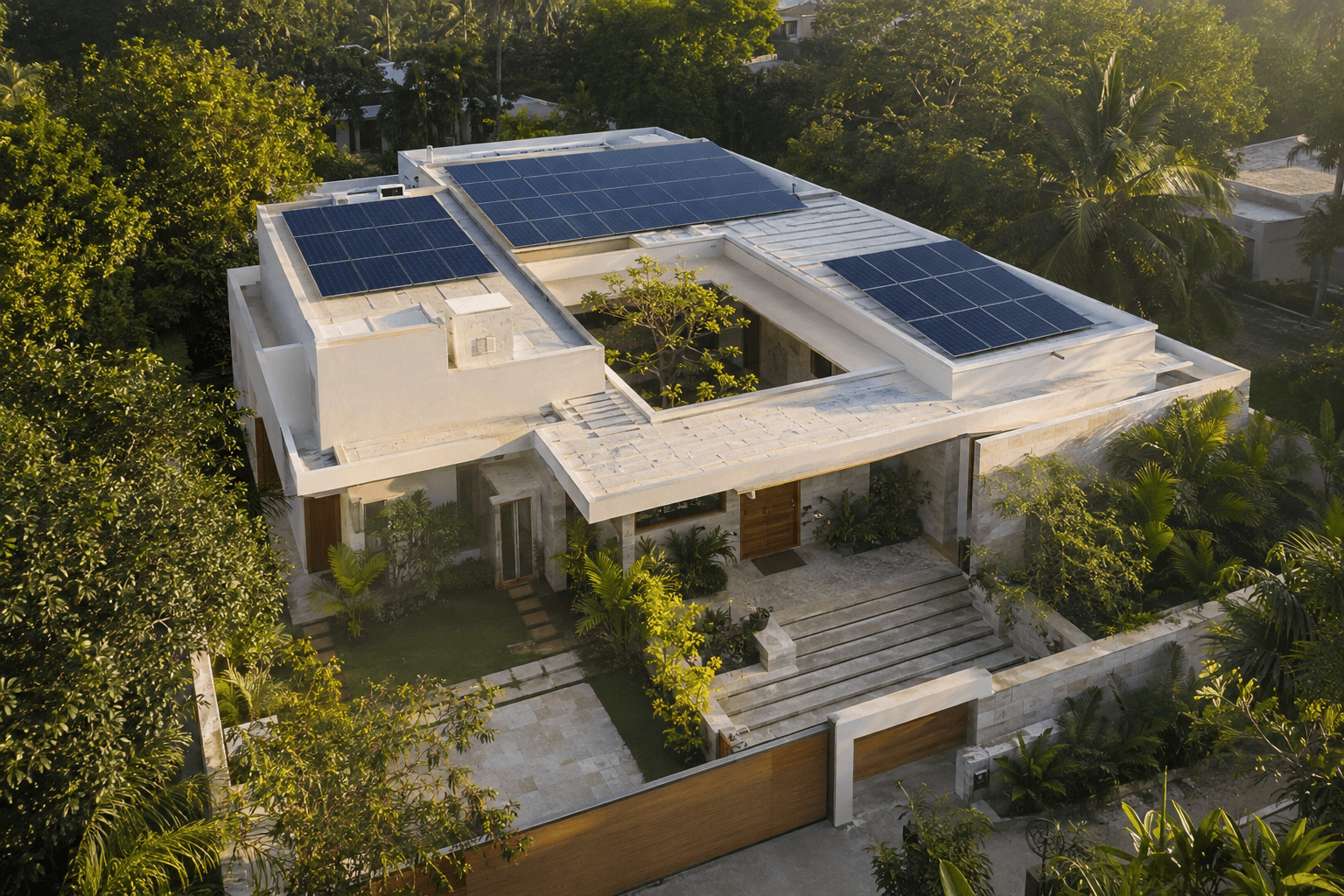
Start with the space you have and the bill you pay. Explore a sample system, with every assumption in the open.
Both bars run on the same scale: your present monthly bill.
About 324 kWh / month under these assumptions. A site survey is needed to determine suitability.
Take this into a roof brief ↗Follow the energy through a home. The layers are simple to understand, even if you’ve never thought about a solar panel.
The modules turn sunlight into direct-current electricity.
Concept diagram. Sun position is an illustration, not a live energy measurement.
This is the 3.0 kW system you shaped above, with its 10% shading allowance, spread across a year. Which way the roof faces changes the shape of that year.
A south-facing array peaks harder in spring. Splitting panels east and west flattens the year and gives up roughly 12% of the annual total.
Sample monthly profile, normalised to the annual total. Rounded monthly labels may differ slightly when added.
A site visit looks at usable space, shade, access and your household’s energy needs.
A proposed layout connects the system, installation approach and transparent cost brief.
Installation, checks and a clear handover help you understand the system you live with.
Our courtyard-house concept keeps panel access, daily use and the shape of the roof in the same conversation.
Uses ₹55,000/kW for this concept; no subsidy included. Actual design and pricing need a survey.
Start a roof briefNo. The calculator uses editable demonstration assumptions. Roof conditions, local tariffs, system design and actual generation would need a site assessment.
No subsidy is included. Current programme rules and eligibility would need verification before a real installer could advise on an application.
This simplified illustration caps the saving at 90% of the sample bill. It is a design demonstration, not a model of your actual electricity connection.